
Strengthening neonatal and pediatric care in hospitals in Busoga Region, Uganda through a cascade training and mentorship model

Situation:
Insufficient quality of care contributes to a high number of premature births and 60% of premature mortality in low-income countries, affecting children's health, education and ability to participate in society. In the Busoga region of Uganda, under-five mortality remains high, driven primarily by complications around birth and infectious diseases in early childhood. To address these challenges and bridge the gap between evidence-based practices and care delivery, a partnership was established in 2020 between the two non-governmental organizations Busoga Health Forum (BHF) in Uganda and Pediatric Health Initiative (PHI) in Sweden. The partnership aims to enhance pediatric care quality by connecting pediatric health care workers from low- and high-income settings through collaborative improvement efforts.
Objectives:
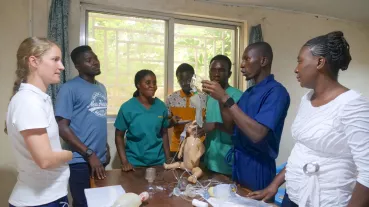
To enhance the quality of care provided to sick children in the Busoga region, Uganda, through a mentorship and training program with the involvement of national and international mentoring of health workers at facilities
1.1 A defined pediatric mentoring group is established
1.2 Regular pediatric mentorship visits are conducted
1.3 Pediatric mentorship tools are developed and used in mentorship activities
1.4 Pediatric local mentors at lower-level facilities are identified for the second year
2.1 Selected mentors will make a study visit to Astrid Lindgren Children's hospital to increase learning on evidence-based practices and mentoring strategies
2.2. Regular meetings between international/JRRH mentors and local mentors are conducted
2.3 Monitoring through the use of mentorship tools at lower-level facilities is performed and reported
3.1. Two ETAT+ courses targeting health workers working with pediatric emergency care at the 6 included hospitals completed
3.2. Two courses performed targeting health workers working with newborns in the six included hospitals
3.3 Half-day training sessions in child rights, neuropediatric, and infection prevention performed at all 6 included hospitals
3.4 Included facilities are equipped with basic requirements for the management of sick newborns and pediatric emergencies (such as pulse oximeter, ambubags glucometers)
The activities of the proposed project address as the direct target group the key medical personnel at the pediatric and neonatal wards of Jinja Regional Referral Hospital and the six high-volume district hospitals surrounding JRRH in the Busoga region, Uganda.
The content of the mentorship program will stretch over two years and aim to improve the competencies, skills, and performance of frontline health workers in Busoga region, Uganda. The mentoring program will encourage mentees to apply evidence-based practices in their daily work.
The project starts with a joint work to develop a mentorship tool to target the most important areas for improvement. Regular mentorship visits will be performed from JRRH to the district hospitals, and with the development of action plans for improved quality of care.
Mentorship visits will be enhanced by training events throughout the project period, both online and in-person.
The purpose of the program is to build capacity and create sustainability at Jinja Regional Referral Hospital (JRRH) to establish a pool of local mentors who can independently continue the developmental work at JRRH and surrounding facilities beyond the initial implementation phase. The involvement of national faculty, including Makerere University and Ministry of Health will ensure that the mentorship is aligned with existing health system structures and processes.
Local health management teams will be involved to support and oversee the mentorship program. To further support sustainability, ways to reduce costs for mentorship activities will be explored and established such as the creation of What’s-App groups to be used for continued meetings and supportive measures. As the Ugandan MoH has a plan for upgrading JRRH to a national referral hospital for pediatrics we believe our activities are in a good position to be sustained as an integrated part of the future hospital structure.
NA
Further information: https://pediatrichealthinitiative.org/