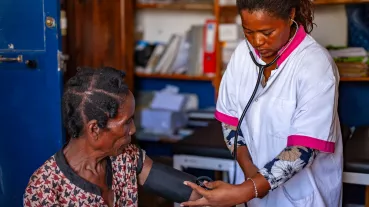

Strengthening the Capacity of Health Centers in Malawi to Treat Infections and Non-Communicable Diseases

Situation:
In Malawi, cervical cancer is the most prevalent cancer in women. The implementation of the national guidelines for cervical cancer is hindered by the weak health infrastructure. The coverage of HPV vaccination as prevention strategy is still low. HPV DNA testing is the recommended standard, being more specific and less invasive than VIA screening, but the latter is still commonly used.
Objectives:
To improve the quality of health services for infections and NCDs, specifically HPV and cervical cancer for the most vulnerable segments of the population living in Balaka District by 2027.
By 2027, 30% of the girls currently living in Balaka District started vaccination before age 15 years and received first or final dose of HPV vaccine in Balaka District.
By 2027, 25% of 25-49 years-old women with HPV infection were diagnosed through a HPV DNA test in the catchment area of Balaka DREAM Center.
One final workshop is organized by the end of the project.
Organization and implementation of eight HPV awareness and vaccination campaigns in schools of Balaka District, targeting 9-14 year old girls.
Organization and implementation of eight awareness campaigns related to NCDs (specifically cervical cancer) in the target health centers, community meeting spots and private companies.
Organization of two training courses concerning HPV DNA testing and delivery of quality and gender-sensitive cervical cancer services.
Conduction of a screening and treatment service for cervical cancer, through the use of HPV DNA testing innovative method.
Advocacy in eight national technical working groups and coordination meetings.
Organization of a final workshop in Balaka District, involving local community and health authorities.
The project aims to ensure the sustainability of the established health services by anchoring them in the communities and gradually transferring funding to the health authorities. Advocacy at the health authorities is focussed on the exchange of lessons learned and the free provision of HPV DNA tests. In the past, the health authorities have already taken responsibility for important components of the centres (staff, all antiretroviral and tuberculosis drugs, rapid HIV tests, reagents for CD4 and viral load tests).
The introduction of advanced diagnostics and the anchoring of modern health services in rural communities is innovative.
Further information: https://www.dream-health.org/