
Advancing quality Public Health Coverage in Malawi through capacity building for community health workers

Situation:
Malawi faces severe health challenges, as evidenced by high maternal and under-five mortality. Key drivers are limited access to medical care - over 80% of people live in rural areas, often far from health facilities - and a shortage of a trained health workforce. Only 15,000 health workers are in place, compared to 25,000 required for adequate care of the population. Each health worker serves about 1,500 people, resulting in poor coverage and quality of care.
Objectives:
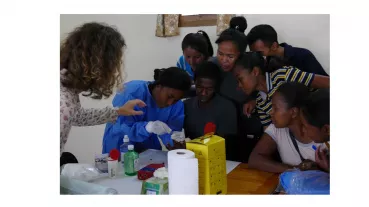
The project aims to close the gap and improve access to quality healthcare especially in remote areas of Malawi by increasing the number of skilled & qualified health workers who deliver health services in a manner that is effective, efficient and equitable.
- # of local health workers trained for the first time under a new one-year curriculum: 40
- # of existing health workers receiving professional training and coaching: 300
- # of participating health workers provided with a specialized bicycle to improve mobility: 75
- # of people with improved access to healthcare services: 105,000
- Health worker training
- Professional development/capacity enhancement for health workers
- Provision of bicycles for health workers
- Technical assistance to Medical Council of Malawi in health systems strengthening
- Health services, especially in remote areas, through mobile outreach clinics
By strengthening local structures, this project will have a long-term impact that extends beyond its duration: in particular, building up the cadre of trained health professionals leads to a structural strengthening of the health system. The technical support provided to the Medical Council further sustains these structural improvements and embeds them systemically.
The provision of bicycles to health workers to improve their mobility is carried out using models specifically designed for rugged terrain by the partner organization “World Bicycle Relief.” A local “ecosystem” of spare parts and trained mechanics further ensures their durability beyond the end of this project.
Further information: https://amrefdeutschland.org/blog/ausbau-der-gesundheitsversorgung-in-malawi/